Piano Teacher
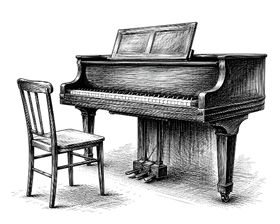
A mother wanted her children
to learn piano properly.
A friend recommended
a highly qualified teacher.
The teacher had certificates,
competition awards,
and photographs
with famous musicians.
So the mother invited her
to teach at their home.
Each week,
the teacher arrived precisely on time.
The mother prepared tea
and placed slices of cake
beside the piano.
The teacher ate politely.
Then lessons began.
The teacher was strict.
And blunt.
One child was praised immediately.
“He has talent,”
said the teacher.
Another child was not.
The teacher frowned
while correcting hand position.
“No.”
“Again.”
“Wrong.”
“Your fingers are weak.”
“Your hands are not suitable.”
The mother trusted the teacher.
Strict teachers produced results.
That was well known.
Exams came constantly.
Preparatory exams.
Theory exams.
Performance exams.
Grade 1.
Grade 3.
Grade 5.
Grade 6.
Then Grade 6 again.
Later,
Grade 7 was also unconvinced.
The teacher loved assigning Bach
for examinations.
Especially the Two-Part
and Three-Part Inventions.
The child hated them.
For an entire year,
the same mechanical piece
echoed through the apartment
again and again and again.
Then there were scales.
Pages and pages.
The child practiced
until her fingers ached.
This, the teacher explained,
built discipline.
The child privately suspected
it was punishment.
Piano grew heavy.
The child rarely played
anything outside assigned pieces.
She barely practiced
those either.
Once,
the child received 100
on a school exam.
As a reward,
the mother asked
what she wanted.
The child chose
to quit piano.
The mother was not pleased.
This, she explained,
was extremely ungrateful.
Piano lessons continued.
Eventually,
after enough failed exams,
the mother changed teachers.
By then,
the child had learned
to hate the piano.
Years later,
after leaving the city,
after college,
and nearly thirty years
after quitting lessons,
the student slowly began
playing again.
This time,
there were no exams,
no scales,
no piano books,
no Bach,
no teacher,
and no judgment.
She simply improvised.
Strangely,
she began to feel music.
She even learned
to appreciate Bach.
Occasionally.
In time, she realized
Bach himself was not the enemy.
Still,
his structures felt uncomfortable.
Beethoven’s roars
spoke more naturally to her.
Yet sometimes,
she still woke
in the middle of the night
with the familiar terrible feeling:
piano lesson was today,
and she had skipped it.
Many years later,
the student accompanied her son
on piano
at his violin recital.
The recital went well.
When the mother heard,
she was deeply concerned.
“Are you sure,” she asked,
“you will not ruin the recital?”
More than thirty years had passed
since the original piano lessons.
The scales ended.
The lessons ended.
The examinations ended.
One thing did not.
The judgment.
The mother herself
did not play piano.